
Galesburg City Directories on Record
The known Galesburg city directory shelf begins with nineteenth-century titles and continues through cataloged twentieth-century runs. Access differs by item. CARLI supplies a digitized transcription for one early volume, the Illinois State Library bibliography points to microfilm, and Galesburg Public Library holds local-history material that needs year-by-year confirmation.
| Collection | Years | Where Held | Access |
|---|---|---|---|
| Annewalt & Lawrence directory | 1867 | CARLI Knox County collection | Digitized transcription/item |
| Dewey's county and city directory | 1868 | Illinois State Library bibliography, Reel 41 No. 157 | Microfilm finding-aid lead |
| Beasley's Galesburg Directory | 1877-78 | CARLI sample transcription | Inspect the source image when available |
| Colville, Polk, and cataloged city runs | 1902-60, with listed gaps | GPL and parallel catalog holdings | Confirm each year and format |
| Galesburg-area phone books | 1907-current finding-aid range, missing years | GPL and Illinois resource guide | Verify title and reverse section in person |
Catalog leads identify runs for 1902-1934, 1936, 1938-39, 1941, 1943-44, 1946, 1949, 1951, 1953, 1956, and 1958-60. They do not prove that every year is digitized or open on a shelf. Ask the archivist to confirm the exact year, publisher, format, and access terms before planning a visit.
Galesburg Library's Directory Room
Galesburg Public Library Archives & Special Collections is on the second floor at 264 W Main Street. The collection names city directories, yearbooks, newspapers, maps, photographs, rare books, manuscripts, and local histories. Contact archives@galesburglibrary.org or 309-343-6118 before visiting because access can vary by item and archivist availability.
A useful request names the person, spelling variants, likely years, and the street or institution. Ask for the directory title and publisher, whether a street-order section exists, and whether pages may be photographed or quoted. If the volume is missing, request a phone book, newspaper year, city-clerk collection, or parallel microfilm lead instead.
The library genealogy page shows the local history and family-research entry point.
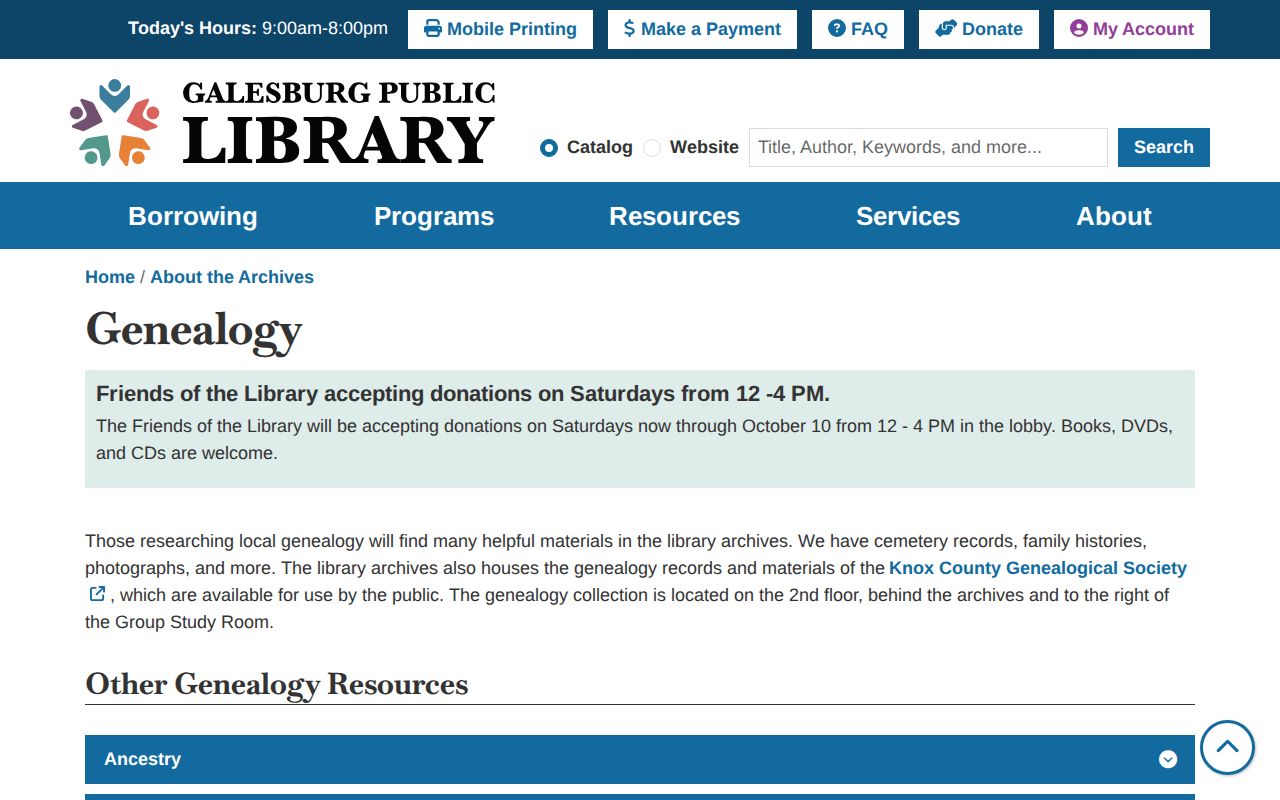
The image confirms the library route. It does not show that every directory year is online, so the volume-level catalog check still matters.
Early Galesburg City Directory Rules
The 1867 Annewalt & Lawrence directory describes itself as a catalogue of inhabitants, institutions, and businesses, but its inclusion rules were selective. The research notes that nearly all males over twenty were included and that the volume estimated the city population at 11,000 to 13,000. Absence is weak evidence. Women, younger people, boarders, and other household members may not appear in the same way.
The 1868 J.L. Dewey volume is a 257-page county and Galesburg city directory known through the Illinois State Library bibliography and microfilm lead. The 1861 Root's title remains a catalog lead without a confirmed official page scan. Label each one honestly: viewed item, transcription, bibliography entry, or shelf lead.
Research tip. Save the title page and inclusion statement with every early directory entry. They explain whose absence means little.
Read a Galesburg Directory Entry
Read the printed line as a set of source fields, not as a modern profile. The safest inventory begins with what is actually visible and records uncertainty. Historical volumes vary, and no mark should be expanded from memory when the volume's own key is available.
| Name | Printed spelling, initials, and any named family relationship |
|---|---|
| Role | Occupation, trade, business, office, or institution exactly as printed |
| Place | House number or narrative street position, with work and residence kept separate |
| Status mark | Boarding, residence, removal, widowhood, or ownership only when the key defines it |
| Citation | Title, publisher, directory year, page, and image or transcription status |
- Criss-cross directory
- A later directory or section arranged by street and house number. Exact Galesburg titles and years remain to be verified.
- Householder index
- An address-order list of named householders, not necessarily every person at the address.
- Abbreviation key
- The publisher's own list of shortened terms. Save it before expanding any entry.
A directory can place a named person near an address on its publication date. It may also list a business, boarder, or future move. Compare the line with a second source before calling it a residence.
A Galesburg City Directory Puzzle
A CARLI transcription from Beasley's 1877-78 volume lists mason Joseph Barquet on the west side of Monroe Street, six doors north of North Street, on page 42. This is a strong local example because the entry preserves name, trade, side of street, relative position, source title, and page. It does not provide a modern house number.
Resolve the wording against the original Galesburg grid, a suitable Sanborn map, adjoining directory entries, and any plat or city record. Count doors only within the historic map context. A demolished building, changed lot, or later numbering system can break a direct match to today's parcel map.
Note: Keep the original narrative address beside any modern candidate and label the conversion provisional until a map, plat, or city record confirms it.
Galesburg Directories Need Companion Sources
The GPL collection guide names records that can fill gaps around a city directory entry. City Clerk elector registers cover 1867-1910. Rotary directories run 1914-2024, Cosmopolitan Club rosters and directories cover 1949-1990, and First Christian pastor notes date from about 1921-1940. These are archival collections, not open name-search databases.
Organization records can identify a dated civic role, meeting, marriage, birth, funeral, or membership. Keep that statement separate from a street claim. An organization appearance does not prove that the person occupied the address printed in a different source.
The library history also explains collection breaks. A reading room existed by 1858, the library organized in 1874, the Carnegie building opened in 1902, and that building burned in 1958. A replacement opened in 1961, followed by the present Main Street building in 2024. Missing years may reflect catalog, format, or survival gaps.
Cemetery material supplies another careful bridge. Linwood and East Linwood records may show a name, burial date, age, section or lot, and a deed-holder lead. Burial date is not necessarily death date, and a lot holder may not be the person buried there. Confirm volunteer index leads with the city cemetery office, then compare the date with a newspaper and the nearest available directory years.
Verify Galesburg Directory Names in Print
Galesburg newspapers can add an event date, obituary, legal notice, business notice, or street reference. The Galesburg historical newspaper archive offers a digital route, while GPL holds newspaper microfilm and can search available papers for an obituary. Catalog dates contain gaps and unknown digits, so inspect the actual issue.
The library's local-history collection interface helps identify related sources and collection names.
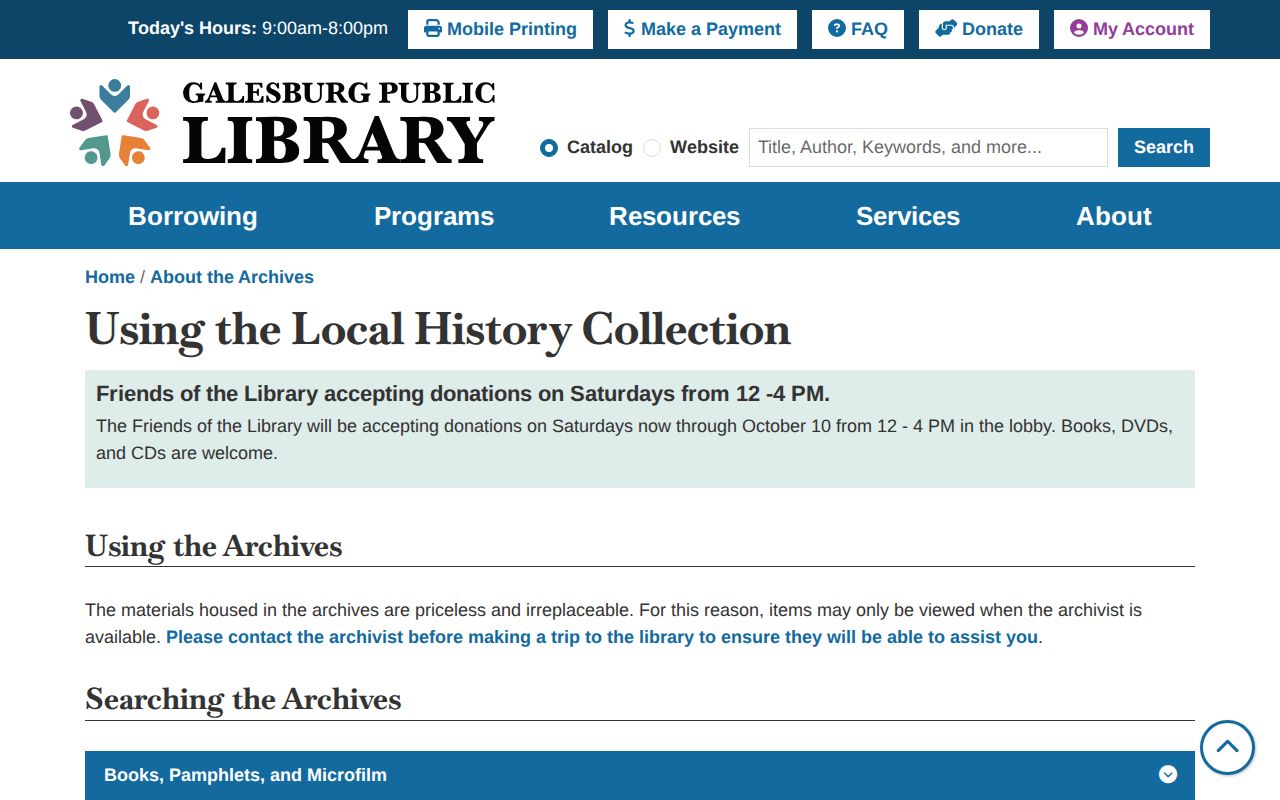
This collection view is a finding aid. Cite the newspaper title, issue date, page, and article alongside the city directory citation.
The separate newspaper search gives another route when a known year or event is in hand.
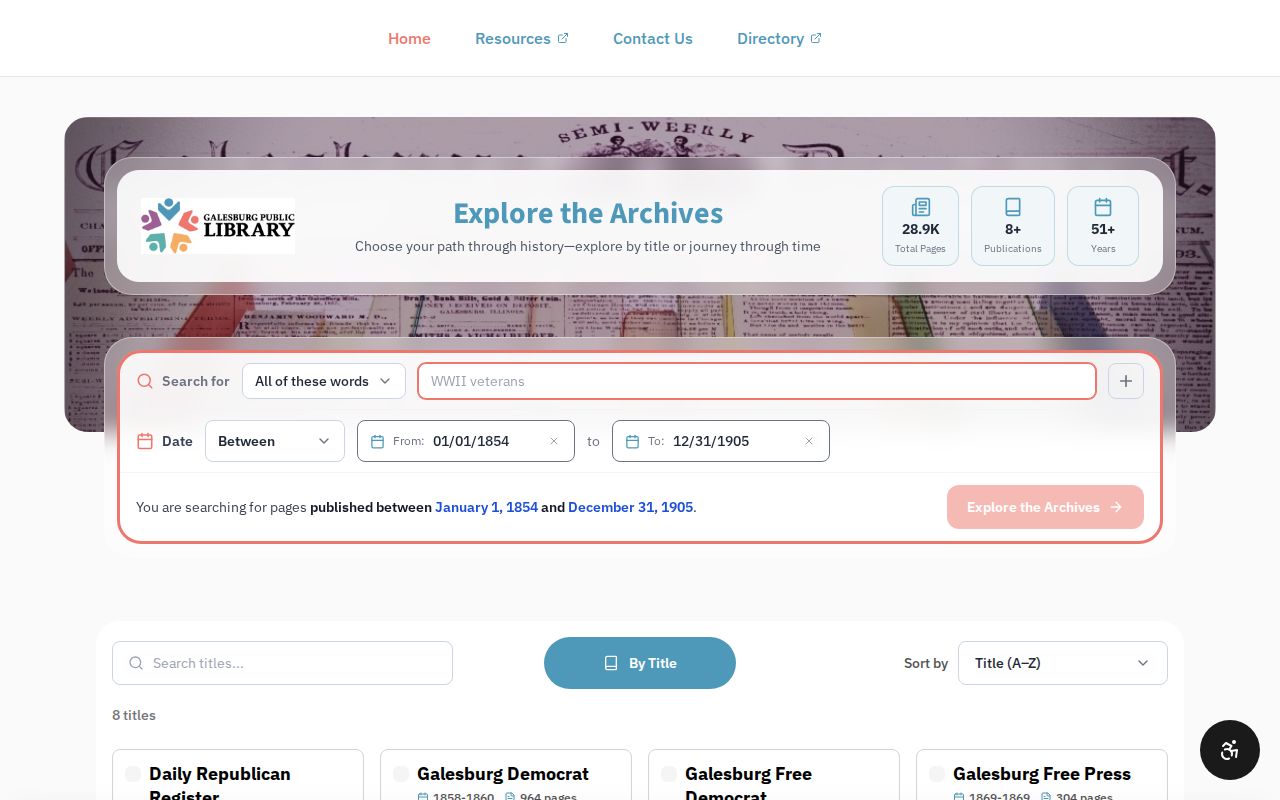
A search hit should lead to the scanned issue. OCR can miss names and old street forms, so try initials, spelling variants, an occupation, and nearby dates.
Galesburg Directory Research Timeline
Several dated milestones help place a directory title within the city's changing record system. They also explain why an early resident may appear under a county-seat, city, or institutional label that looks unfamiliar now.
| 1854 | The railroad connection adds a strong depot and business geography to later records. |
|---|---|
| 1866 | The municipality formed as West Galesburg; later sources use City of Galesburg. |
| 1867-68 | The first confirmed early directory pair provides named listings with distinct inclusion rules. |
| 1873 | The county-seat move from Knoxville to Galesburg was settled by court decision. |
| 1888-1927 | Seven Sanborn map sets create a dated bridge between directory streets and buildings. |
| 1958 | The Carnegie library burned, an important part of the local collection history. |
A directory date should be compared with this local timeline, not treated as a free-standing fact. The two-town county-seat trail is especially useful for probate, naturalization, and court records.
West Galesburg, City of Galesburg, Galesburg Township, and Knoxville are date-sensitive labels. Keep the form printed in the source. A person tied to Galesburg may have an earlier Knox County record filed under Knoxville because of the county-seat history, while a township label can describe a different boundary than the city. Place names are evidence, not interchangeable search terms.
Trace Family Through Galesburg Directories
Family history grows stronger when each Galesburg city directory entry is treated as one dated point. Follow the printed spelling and address across available volumes, then use census, newspaper, cemetery, deed, probate, naturalization, church, or elector records to test the pattern. The 1890 federal census is a permanent gap, and the 1950 census is the latest public census under the 72-year rule.
- Locate the first confirmed entry and save its full title, year, page, and abbreviation key.
- Check the prior and next available volumes, noting spelling, role, street, and every gap.
- Compare a public census year, keeping household relationships separate from directory assumptions.
- Search a same-period newspaper, elector register, deed, probate file, or church note.
- Close the trail with an obituary or Linwood/East Linwood cemetery record when appropriate.
A disappearance may mean a move, death, changed spelling, publication gap, selective inclusion, or an unlisted entry. Record the negative search with the exact title and year. That is more useful than claiming the person left Galesburg.
For older government records, search the Knox County IRAD inventory before contacting the Western Illinois University repository. Series include deeds, vital records, naturalization, probate, elections, city minutes, and justice records. Ask about copy rules and exact series coverage.