
Start a Galesburg Residents Directory Search
A useful Galesburg search begins with the record type, not a broad name sweep. The Knox County assessment roll connects owners with parcels. The Clerk & Recorder index follows deeds, liens, and other recorded instruments. Illinois election tools can confirm a registration when the required facts are known. Judici provides the public Knox County court route. Galesburg Public Library carries the historical trail.
No roll covers every resident. A tax card usually names an owner, not every person at the address. Voter tools omit people who are not registered and protect confidential records. A directory reflects its publication date and inclusion rules. Treat each result as one dated clue.
- Search City ParcelSearch or Knox County Devnet by name, address, or PIN.
- Use the Illinois registration lookup when the required name and address facts are available.
- Check Tapestry or Laredo for a deed trail, then request an image or certified copy if needed.
- Search Galesburg Public Library directories and newspapers for dated historical links.
- Ask the correct custodian for a counter search, copy, or Illinois FOIA response when the web route stops.
Offices Behind the Galesburg Residents Directory
Galesburg records divide by legal purpose. The Knox County Clerk & Recorder keeps recorded land instruments, county elections, and restricted vital records. The Assessment Office maintains parcel values and tax cards. The Circuit Clerk keeps court files, with Judici serving as the public search layer for many cases. City Clerk material and municipal requests run through the City of Galesburg. The detailed address chain belongs in the Galesburg street directory.
Knox County Clerk & Recorder
200 S Cherry Street
Galesburg, IL 61401
309-345-3815
Knox County Assessment Office
121 S Prairie Street, Suite 1
Galesburg, IL 61401
309-345-3845
Knox County Elections
200 S Cherry Street
Galesburg, IL 61401
309-345-3858
Two Galesburg Property Portals, Two Views
Galesburg has a useful two-step property route. City ParcelSearch accepts a PIN, address, or owner and places the match on an advisory map. It is well suited to finding a parcel and seeing its setting. The viewer warns that the map is not a field survey. Boundaries and measurements therefore remain clues, not legal conclusions.
Knox County Devnet wEdge goes deeper into the assessment record. Its search includes parcel number, site address, sale date, property class, township, tax district, and mobile-home criteria. A sampled parcel card offered tax years from 1993 through 2026, while earlier online card coverage was not established.
| Portal field | Best use | Important limit |
|---|---|---|
| PIN or parcel number | Carry one property across systems | Not a resident identifier |
| Site address | Find the taxed location | May differ from mailing address |
| Owner name | Locate an assessment account | Does not list all occupants |
| Sale date | Choose a likely deed period | Confirm in recorded instruments |
| Township or tax district | Separate legal geography | Not the same as postal city |
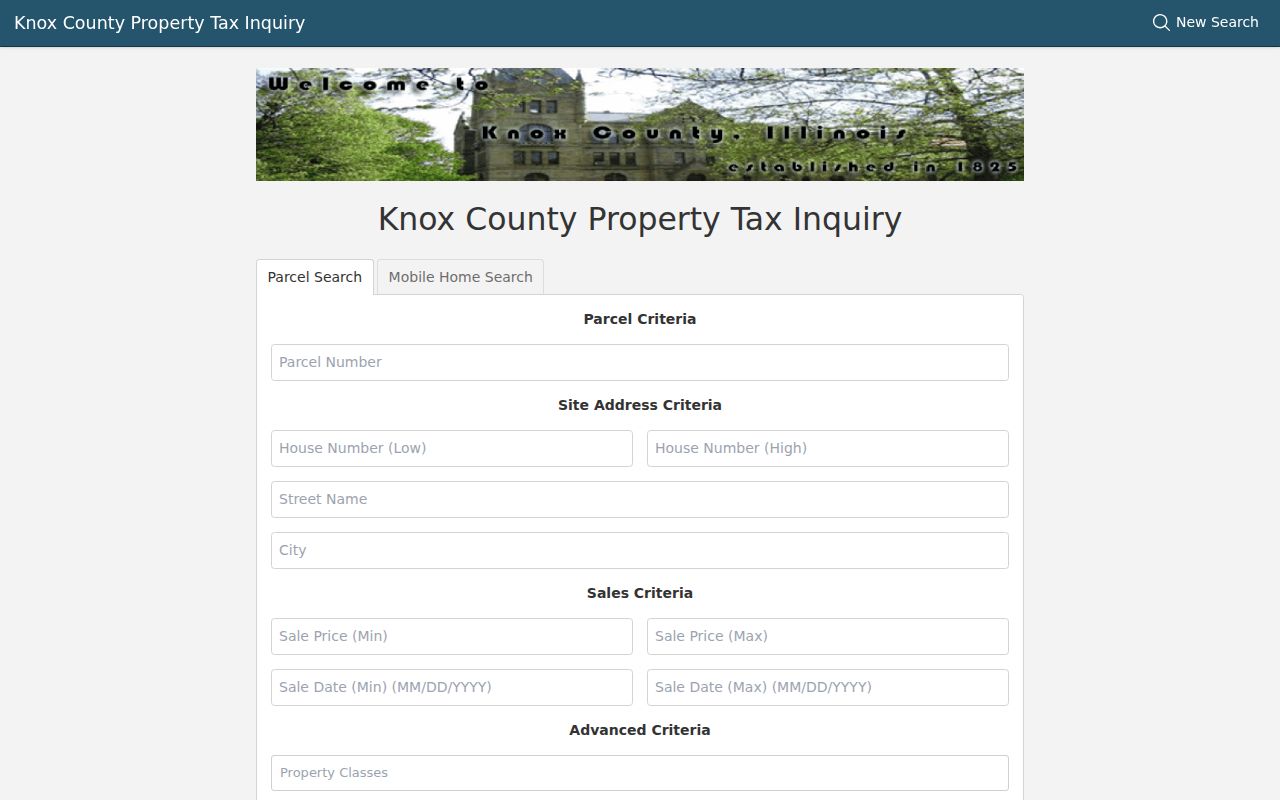
The captured Devnet screen shows why a property roll works best as a structured starting point rather than a complete household directory.
The Galesburg Deed Index Has Two Doors
The Clerk & Recorder offers different access channels for recorded land documents. Tapestry serves occasional users and supports grantor, grantee, date, consideration, and legal-description research. Search and image charges apply under the county instructions. Laredo is the subscription route, with plan and print terms described by the county. Both point back to recorded documents rather than the tax roll.
In-person help remains important. The office receives recordings at the Knox County Courthouse and sets a same-day processing cutoff. A requester can also contact the office about copies or an index problem. When a modern deed and a Devnet owner field disagree, dates matter: a county board record says incoming Laredo deeds feed names and sales tabs in Devnet. A short update lag can explain the seam.
Record term: an index points to a document; it is not the document image, and a tax card is not a deed.
Current Galesburg Residents Directory Sources
Today’s directory-like sources are separate official indexes. Each covers people because of a specific public act, such as owning a parcel, registering to vote, recording a deed, appearing in a public case, holding a state license, or serving as an officer of an Illinois entity. None is a master list.
| Source | Who It Lists | Keeper | Access |
|---|---|---|---|
| Property and tax roll | Parcel owners | Knox County Assessment Office | Free Devnet portal |
| Registration lookup | Registered voters who supply matching facts | Illinois State Board of Elections | Free status lookup |
| Recorded-document index | Parties to deeds and liens | Knox County Clerk & Recorder | Tapestry or Laredo |
| Public court index | Parties in public Knox County cases | Knox County Circuit Clerk | Judici, subject to access controls |
| Professional license lookup | Illinois regulated licensees | IDFPR | Free state lookup |
Match the tool to the claim. Devnet can support ownership. The registration tool supports status, not a public neighborhood roster. Judici needs case-level review, because a name match alone does not establish identity. For a careful one-name workflow, use the Galesburg resident lookup.
Galesburg Court Names Need Case-Level Checks
Judici is the public Knox County case-search route. Public results can include case history, parties, charges or civil dispositions, hearings, payments, and documents when available. The live form was behind hCaptcha during research, so a failed automated search is weak negative evidence. Minors, sealed cases, and secured documents remain outside public view.
The Knox County Circuit Clerk holds the local files and offers counter access and copies for public material. Federal cases are separate and use PACER. A reliable residents directory note records the court, case number, role, and filing date. It never turns a shared name into a conclusion.
The captured access screen also documents why the Circuit Clerk is the proper fallback when the public web form does not open.
Illinois Voter Data Is Not a Household Roll
The state registration lookup asks for first name, last name, birth date, and ZIP, followed by street number and street name. It is designed to confirm a voter’s own status and polling information. The broader computerized voter file has a different request process, statutory limits, costs, and refresh schedule. Neither route should be presented as an open list of every Galesburg household.
Illinois also operates an Address Confidentiality Program under 750 ILCS 61. Eligible participants use substitute-address and protected voter procedures. FOIA personal-information exemptions and other confidentiality rules add more limits. A missing public address may therefore reflect protection, not absence from Galesburg.
Use public records for lawful personal research. Never use a Galesburg residents directory trail to stalk, harass, or expose a protected address.
Galesburg Vital Records Follow Eligibility Rules
Birth, death, and marriage certificates are not open name lists. The Knox County Clerk uses applications, identification, relationship or eligibility checks, and fees. Illinois Department of Public Health provides the state fallback. Restrictions arise under 410 ILCS 535/24-25, while genealogy access depends on the record type, age, and purpose.
Historical indexes offer a safer bridge. Pre-1916 local indexes may be available for genealogy. Archival reproduction standards and statutory genealogy thresholds differ, so the requester should confirm the rule with the custodian before ordering. The useful directory method is to begin with a dated name clue, then request only the record for which the researcher qualifies.
Galesburg Archives Extend the Directory Trail
Galesburg Public Library Archives & Special Collections holds city directories, newspapers, maps, photographs, manuscripts, and yearbooks. Its genealogy resources include cemetery and local-family material. Access varies by collection, so the catalog, reading room, digital site, email, and staff research route all matter.
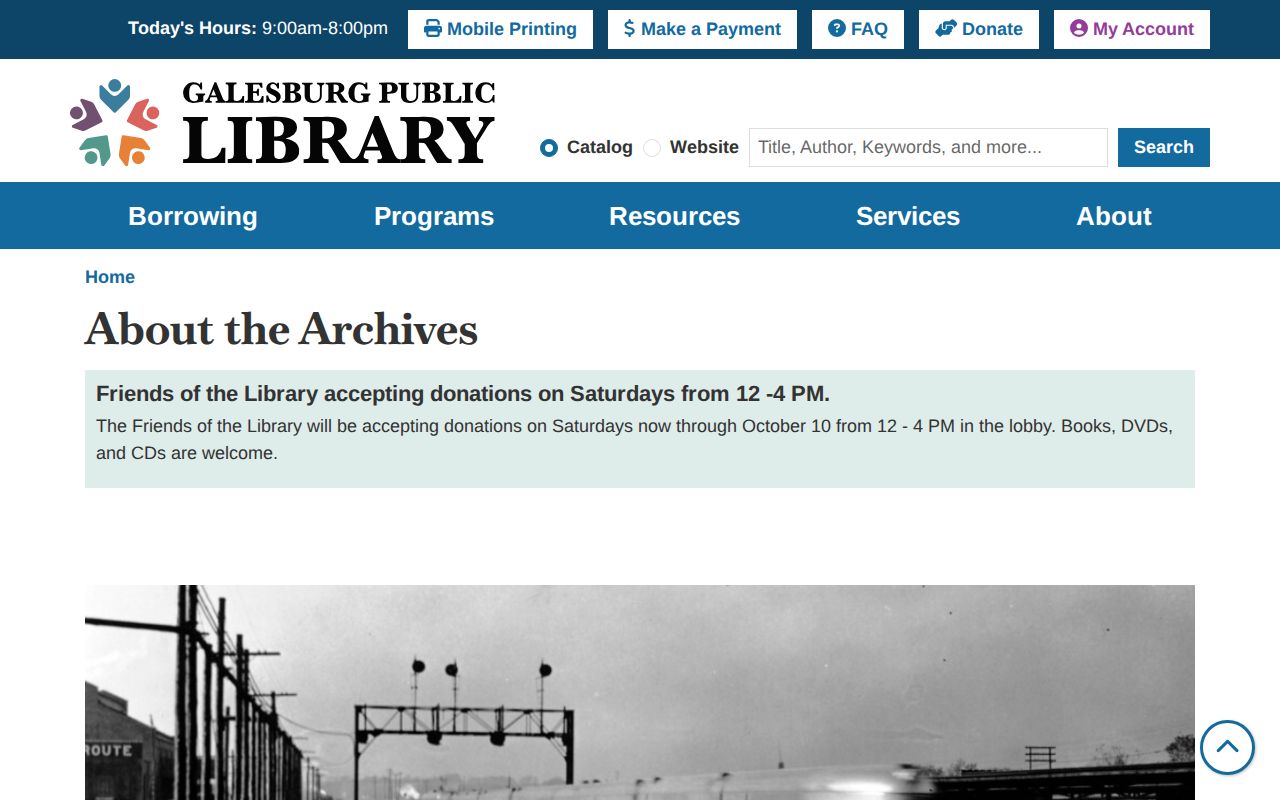
The library screen identifies the local collection hub that joins printed directories to newspapers, maps, and archival descriptions.
Knox County IRAD records at Western Illinois University add deeds, probate, naturalization, marriage, voter, and local-government series. Illinois State Archives databases add statewide historical indexes. Together, those channels explain why an online miss should lead to a repository check rather than a claim that no record exists.
Official Galesburg Rolls Versus Search Vendors
Official sources are slower but easier to audit. A Devnet result names its county source and tax year. A recorded deed carries an instrument reference. A Judici entry identifies the court and case. A library catalog points to a volume or collection. Those details let a reader return to the custodian, inspect context, and request a copy.
Commercial search vendors combine public and private data, then rank possible matches. Their records may lag, merge names, or retain an old address. They can suggest a lead, but they do not replace a parcel card, deed, court file, or archival image. No commercial vendor is linked or endorsed here.
| Question | Official starting point | Why it is stronger |
|---|---|---|
| Who owns a parcel? | Knox County Devnet | Dated assessment account and PIN |
| Who transferred title? | Clerk & Recorder index | Instrument and legal description |
| Does a public case exist? | Judici or Circuit Clerk | Court, case number, role, and history |
| Who appeared at an old address? | Galesburg Public Library | Named edition or archival collection |
Keep a search log with the date, exact spelling, fields used, coverage, and access problem. That record makes a later correction possible and prevents a weak online miss from becoming a false claim.
Galesburg Place Labels Change the Search
Galesburg is the Knox County seat, but older records do not always use the same place label. The county seat moved from Knoxville after an 1869 vote and a 1873 court decision. The courthouse trail therefore spans two sites and eras. An early probate, marriage, naturalization, or justice record may be filed under Knox County or Knoxville even when the person later appears in a Galesburg directory.
Postal, municipal, township, and tax geography also differ. “Galesburg, IL” in a mailing address does not prove that a parcel lies inside city limits. USPS verifies delivery geography. ParcelSearch addresses the city map. Devnet supplies township, tax district, and legal parcel fields. Annexation packets and legal descriptions resolve harder boundary questions.
The 42-block original grid, Five Points, the depot corridor, and surviving brick-street segments offer useful historical clues, but each must be tied to a dated map or city record. A place name is evidence only when its source and date travel with it.
Historical Galesburg Residents Directory Shelves
Galesburg directory research reaches back to early volumes from 1867 and 1868, later commercial directories, telephone books, and address-oriented sources. An 1877-78 entry can even describe a Monroe Street location as “six doors north” of another street. That wording must be reconciled with period maps before anyone assigns a modern house number.
Library of Congress Sanborn sets cover Galesburg in 1888, 1892, 1898, 1906, 1911, 1918, and 1927. They show building footprints, materials, uses, and street orientation. City Clerk elector registers from 1867 through 1910 provide another dated bridge. The full shelf, abbreviations, and household-tracing method appear in the Galesburg city directory collections.
The best historical residents directory keeps source layers distinct. A directory says a person was printed at a place in one edition. A Sanborn map describes the site. A newspaper adds an event. A deed proves a recorded transfer. A census is released under its own schedule. Agreement across those layers makes a strong case, while silence in one source is only negative evidence.
Record the repository, volume, page, date, and spelling exactly. Those five details let another reader test the same Galesburg trail later.